
Book Review: Cólm Tóibín’s The News from Dublin
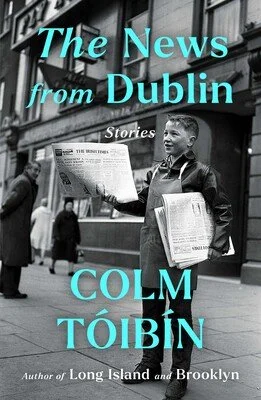
Irish writer Colm Tóibín has won much acclaim for his novels, among them Brooklyn, Long Island, The Master, and The Magician. But he’s also is a prolific short-story writer, and he’s returned with a collection whose stories range across place and time—from contemporary to historical.
Many of the stories in The News From Dublin follow characters in extreme situations. In “The Journey to Galway,” a mother has learned that her airman son has been killed in World War I, and as she travels to give the news to her daughter-in-law, she ruminates on having lived with the uncertainty of a son at war, an experience compounded by their differences—he fought for the British and she’s for Irish independence. In the acknowledgements, Tóibín notes that the story draws on a biography of Lady Gregory, the Anglo-Irishwoman who founded the Abbey Theater.
Sometimes the extreme situation is exile: “A Free Man” follows Joe, a lonely Irishman on parole, trying to set up a life in Barcelona—he can never return to Ireland because of his notoriety. And in “Five Bridges,” one of the collection’s strongest stories, Paul, an undocumented Irishman in San Francisco, has a last outing with his tween daughter and her mother and stepfather before he leaves the U.S. after President Donald Trump’s 2024 election.
These stories quietly inhabit each character, their experiences, observations and slow comings-to-terms with difficult realities, which makes for compelling and often surprisingly suspenseful reading.
Longtime Tóibín readers will be pleased to encounter characters from Tóibín’s fictionalized universe set in Enniscorthy, Ireland. The title story, which takes place in the mid-20th century, centers on Nora Webster’s husband Maurice (from Tóibín’s novel Nora Webster); Maurice is sent on a quest to help save his brother, who has tuberculosis. The story sets the traditional expectations of a small town against a modernizing, independent Ireland. In “A Sum of Money,” the teenage Dan is also from Enniscorthy, and his classmate Donal is Nora and Maurice’s son; Dan boards at a school where he’s been set up to fail, and we watch him try to manage this impossibility.
The collection’s final story, “The Catalan Girls,” is almost a novella. Montse, youngest of three 60-something sisters, receives a letter with news of an aunt’s death in Spain—the sisters have inherited her house. As Montse forms a secret plan, the narrative reveals the family’s story: 50 years before, the sisters and their mother left Spain for Argentina, and the sisters grew estranged as they tried to adapt to the new culture.
Restraint could be the watchword for Tóibín’s style. These stories quietly inhabit each character, their experiences, observations and slow comings-to-terms with difficult realities, which makes for compelling and often surprisingly suspenseful reading. As in so much of Tóibín’s work, the stories in The News From Dublin also powerfully highlight what characters choose not to say, and the consequences of not speaking. All together, it’s a beautiful, well-rounded collection.
—Sarah McCraw Crow
Originally published in BookPage magazine